
Research
2026 holiday shopping trends: The impact of holiday ads, AI use case shifts, the impact of rising costs and more.
Learn more


Identity resolution is the most critical part of marketing, but it’s also the most difficult to do correctly.
As an example: My friend Nicole needed to buy new pants for her kids—their ankles were starting to show a tad too much in their joggers. She browsed several go-to retailers online and ended up making a purchase. She’ll soon be the proud owner of eight more pairs of boys’ athletic pants (because they refuse to wear anything but).
A couple hours later, Nicole opened Safari on her iPhone and was welcomed with ads—for all of the same pants she just bought.
Not only is this a poor experience for Nicole, but think about how many other customers of that retailer are having the same experience. At scale, that is an enormous amount of wasted ad spend.
In a digital world where consumers expect highly relevant and personalized experiences, Nicole’s story is all too common. More often than not, these stories are the result of poor identity resolution.
We recently partnered with Forrester Consulting to understand how well (or not well) marketers are using identity resolution and come up with recommendations to solve for problems like ad waste and subpar experiences. In the full Forrester identity research, they surveyed more than 200 brand marketers on their identity resolution strategies and how they apply to their marketing efforts.
As we take a look at just the retail marketers’ responses from the survey, it turns out that they have some unique struggles when it comes to identity resolution.
Retail brands in our survey with Forrester indicated that their top priorities include:
They want to make happy customers. Find and engage new ones. Convince everyone they should buy more. But poor identity resolution is hampering results. Retail respondents report that they are struggling to use data to:
When it comes to building an understanding of their customers, brands need a sound structure, propped up by the five pillars of identity:
Retailers struggle in particular with scale (73%) and recognition (73%).
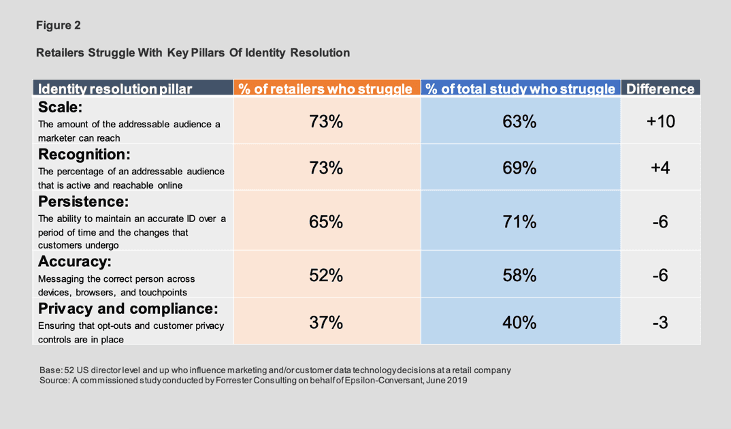
To illustrate a failure with scale, consider an athletics apparel company. The brand may accidentally oversaturate and fatigue their existing customers with messages to purchase new performance running shoes, while leaving out a large portion of other potential customers that are, in fact, in the market for shoes.
As for recognition, imagine a personal electronics company failing to suggest a wearable device to a customer even though they’ve shown interest in that product specifically through research on their work computer, and are currently active on the website on their Android phone.
Because of failures in the retailer’s identity resolution program, they aren’t recognizing this as the same person, so they serve them for a different product that appeals to a broader base instead, missing the opportunity to bring them further down their purchase journey.
Similarly, the retailer my friend Nicole was shopping with could have served her messages for complementary clothing and sneakers to match her boys’ new sweatpants as opposed to sending her ads for something she already purchased.
First, retailers are underperforming against core marketing goals without a complete view of customer.
Only 35% of retailers say they use their customer identity resolution program to connect with their preferred audience and segment customers (compared to 41% of companies surveyed overall). Retailers are also the least likely to use their program for customer journey analytics.
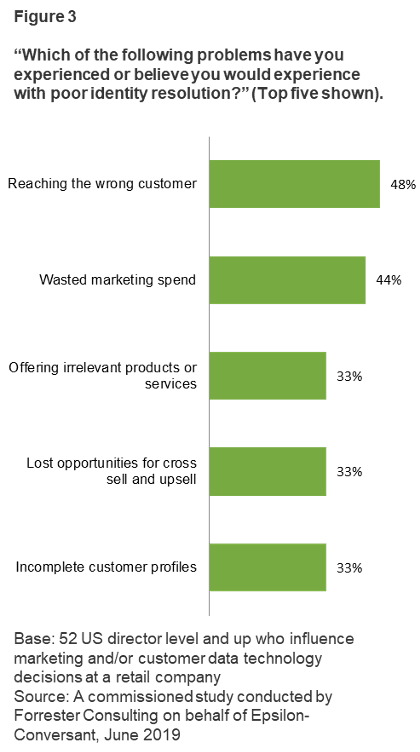
As a result, nearly half of retailers say that poor identity resolution leads to reaching the wrong customer. This failure of marketers to use their identity programs strategically in order to learn more about their customer, map their journey and interact with them accordingly inevitably leads to wasted spend and ineffective marketing.
Second, limited identifiers are limiting retailers’ performance. As Forrester’s report explains:
“More than any other industry we surveyed, retailers rely on email, IP addresses, and login data from their website to identify customers across devices and touchpoints. Meanwhile, offline transactional data and device IDs are being used by far fewer retailers (44% or fewer). Even more surprising, only half of retailers say they use online transactional data to identify customers—the type of data that retailers likely have more of than any other.”
Online and offline transactional data in particular help contribute to a robust customer identity—but our research with Forrester indicates that most retailers are leaving this valuable data out.
The retailer in Nicole’s story may have failed to identify her correctly across devices to provide relevant messaging. But this brand—and others like it—have a clear opportunity to do better.
Nicole bought boys’ winter sweatpants this time. The next ad she sees across her devices could be for boys’ athletic socks (yes, they need non-stink). When spring rolls around, the brand could offer her athletic shorts and wicking tank tops.
As Forrester’s identity resolution research indicates, retailers can better deliver against their primary goals of improving customer satisfaction and increasing revenue by advancing their understanding of customer identity.

Melanie Franke is the director of content marketing at Epsilon, where she leads brand-level content marketing strategy and programs. She is also the managing editor for CORE, a biannual publication from Epsilon that tackles CMO-level topics, challenges and solutions.

