
Video
The Real Deal on Identity Resolution
Learn more


Retail media networks (RMNs) have entered a new phase of maturity. Growth remains strong—roughly 30% year over year—but the conversation is evolving. Today, the question isn’t whether retail media works, but how it works at scale.
Over the past several months, a wave of high-profile industry partnerships has underscored just how quickly retail media is becoming embedded in the broader digital advertising ecosystem. Demand-side platforms are opening access to on-site retail inventory. Enterprise search budgets are flowing directly to retailer properties. Programmatic, search and retail media are starting to converge, giving brands new ways to access retailer shoppers at scale.
On the surface, these developments feel like real progress:
But as retail media grows, access alone won’t be enough. In fact, a recent white paper from IDC, sponsored by Epsilon, Identity Drives End-to-End Retail Media Outcomes, suggests that the hardest problems—like identifying shoppers and measuring performance across channels—become more important, not less, as retail media scales.
Fragmentation has long shaped how retail media is bought. Advertisers have had to work through inconsistent buying experiences, limited interoperability and measurement that differ from retailers and platform to the next. To try to address this, the industry has focused on building integrations designed to make buying retail media easier.
The new programmatic and search-driven entry points for advertisers unlock incremental budgets and bring new demand to retail media. These are meaningful advancements, and from a buying perspective, these changes matter.
But the white paper from IDC suggests that easier buying only solves part of the problem. Fragmentation at the identity and data layer plays a much larger role in determining whether retail media drives outcomes, and whether advertisers will ultimately pull spend if those outcomes can’t be proven.
The IDC white paper indicates that many of retail media's most persistent challenges (imprecise targeting, disputed attribution and incomplete measurement) stem not from how media is purchased, but by how customers are identified and understood across environments. When identity is fragmented, better access may increase efficiency without improving outcomes.
Over time, this creates a widening gap between demand and confidence. Media becomes easier to sell, but harder to measure in a way that clearly demonstrates value to advertisers and sustains growth over time.
The IDC white paper is clear on one core point: person-level identity sits at the heart of effective retail media. “Person-level identity is key to targeting, attribution and data within the retail media ecosystem,” writes Ananda Chakravarty, vice president for IDC retail insights. “It is also critical to both brand and performance.”
Yet many retail media networks today are still working with identity approaches that are incomplete or inconsistently resolved. These approaches often rely on probabilistic methods, where attributes like IP address or browser type are given a score to make an educated guess about a person’s identity. While useful in some contexts, they make it difficult to maintain a single, consistent view of the shopper across channels. As media moves offsite or flows through partner integrations, identity signals are frequently lost due to discrepancies in attribute values and the use of different identifiers, making it even harder to recognize and reach real shoppers.
That complexity only increases as retail media expands into programmatic and search-driven ecosystems. More platforms and partners mean more identity handoffs, and with each handoff comes a greater risk of losing real shoppers along the way. While these ecosystems are built for scale, they are not inherently designed to preserve retailer-owned identity across the full media lifecycles. Over time, shoppers will be lost in the process.
The IDC white paper characterizes this as both a compute and modeling challenge. Because shoppers move seamlessly across channels, devices and physical locations, accurately capturing that journey depends not just on access to inventory, but on maintaining identity continuity as shoppers move from interaction to interaction. According to Chakravarty, “Most retailers are unable to keep the promise of high attribution accuracy because of the nature of shopper buying.”
One of the big promises of recent retail media integrations is "holistic” measurement. Bringing additional data sources together can certainly improve visibility across the customer journey, but the IDC white paper is clear: even in the best-case scenario, attribution is rarely simple.
Attribution windows vary, and outcomes are influenced by factors such as pricing changes, promotions, competition, seasonality and broader market conditions. As AI and machine learning play a larger role in attribution, the quality and consistency of identity inputs become even more important. Simply put: poor identity in, poor insights out.
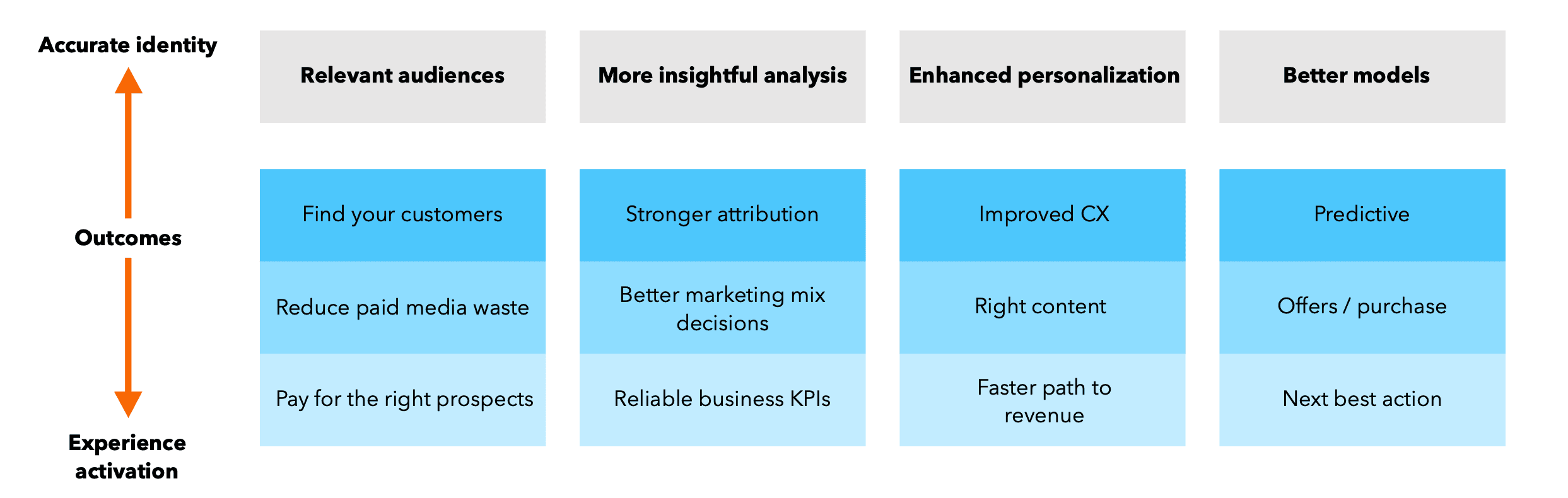
As retail media is activated across multiple buying paths—on-site, off-site, programmatic and search—the challenge goes beyond assigning credit. The real question becomes whether outcomes can be tied back to real shoppers.
For retailers, that confidence matters. RMNs are not just monetization tools; they are strategic businesses that depend on long-term trust from brand partners. When measurement lacks clarity or consistency, it erodes trust and diminishes justifications from brands to increase or maintain spends, regardless of how much demand flows into the ecosystem.
The IDC white paper highlights a common characteristic among higher-performing networks: they strive toward end-to-end retail media services from a single vendor. This focus is driven in large part by a desire for greater control and better alignment across activation, measurement and attribution as retail media programs scale.
Single vendor end-to-end approaches can give retailers clearer visibility across the full media lifecycle, helping maintain one view of the shopper and making it easier to execute campaigns reliably across channels. Because these systems are designed to work together, retailers can add new media and channels without adding unnecessary complexity or friction. Over time, this leads to stronger governance, greater confidence in data quality and more reliable outcomes for brand partners.
The IDC white paper points to in-store media as the next major inflection point for retail media. Nearly two-thirds of surveyed retailers expect their networks to support in-store advertising, reflecting growing interest in extending retail media beyond digital touchpoints and closer to the moment of purchase. Per Chakravarty, “The focus on the store is critical as a future effort and domain builder for retail media.”
But in-store environments raise the stakes for identity resolution. Connecting ad exposure to purchases in physical locations requires high-confidence identity, clean data and attribution models that link media directly to real transactions. Tactics that work well online don’t always carry over seamlessly offline, making identity continuity even more important.
Retailers entering in-store media with fragmented identity systems may find it harder to demonstrate value at scale. By contrast, those that have invested in identity-first design are better positioned to extend retail media across channels while preserving measurement integrity.
The recent wave of partnerships shouldn’t be read as step backwards for retail media. If anything, it reflects confidence in the channel’s future and a genuine effort to make retail media easier for advertisers to access and activate.
At the same time, the IDC white paper suggests that expanding access alone is unlikely to unlock retail media's full potential, especially as programs scale and expectations rise.
For retailers building or scaling RMNs today, this creates an opportunity to step back and evaluate how their retail media foundation is designed. Key questions include:
The answers to these questions shape more than near-term revenue. They influence long-term credibility and the ability to grow sustainably.
As retail media continues to evolve, the IDC white paper suggests that long-term success will be shaped less by who unlocks the most demand, and more by who delivers the most consistent and reliable outcomes. Chakravarty emphasizes this in the white paper: “For retailers to realize the gains of retail media, across broad competition, there must be a focus on outcomes.”
Identity is what turns expanded media access into media performance.
Platforms designed with identity integrated across activation, measurement and attribution can reduce signal loss, improve confidence in results and support more durable partnerships between retailers and advertisers.
At Epsilon, this philosophy has guided our approach to retail media from the start. Our suite of retail media solutions is built with identity resolution embedded throughout, enabling retailers to activate media across channels while preserving connections to known shoppers. The result is not just scale, but accountability, an increasingly important requirement as retail media matures.
Retail media is expanding rapidly. The retailers who win won’t just ride the wave—they’ll build the identity foundation that lets them steer it.

Jason Del Re is a Senior Product Marketing Manager for Retail Media at Epsilon.

