
Blog
How to plan your 2027 media budget beyond the major platforms
Learn more

Cookies help websites recognise returning visitors and remember information such as logins, language preferences or items in a shopping cart. Because web servers have no inherent memory, these small browser files allow sites to store information that improves usability and enables more relevant marketing experiences. The most important distinction for EMEA marketers is between first-party cookies and third-party cookies, which differ primarily in who sets and reads them, and increasingly, which browsers allow them.
While most marketers understand this broad idea, the distinctions between different types of cookies can be less clear. The most important distinction is between first-party cookies and third-party cookies, which differ primarily in who sets and reads them.
That distinction matters more than ever. Browsers and regulators across Europe have increased scrutiny of online tracking, and although Google ultimately cancelled its plan to fully deprecate third-party cookies in Chrome, the environment around them has changed significantly. Consumer behaviour is shifting too. 48% of UK adults say they accept cookies when visiting a new site, while 21% reject them (ICO/Savanta, 2024). For EMEA marketers, cookie-based strategies still exist, but they now operate within a tighter regulatory and privacy landscape shaped by GDPR.
For marketers, cookie-based strategies still exist, but they now operate within a more complex privacy landscape.
Before exploring how cookies are used in advertising, it helps to understand the two main categories. Both use the same browser mechanism. The difference lies in which domain sets and accesses them.
A first-party cookie is created by the website a user is visiting directly and can only be read by that site’s domain.
First-party cookies support essential website functions, including:
Because they support core site functionality, first-party cookies remain widely supported across browsers.
A third-party cookie is created by a domain other than the one the user is visiting. These cookies are typically placed through advertising tags, scripts or embedded content.
They have historically enabled:
Today these uses operate under stricter consent and transparency requirements, and many users actively limit tracking. Around one-third of UK consumers say they use an ad-blocker (YouGov, 2024).
From a technical perspective, first- and third-party cookies use the same file structure. The key difference lies in who creates the cookie and where it can be read.
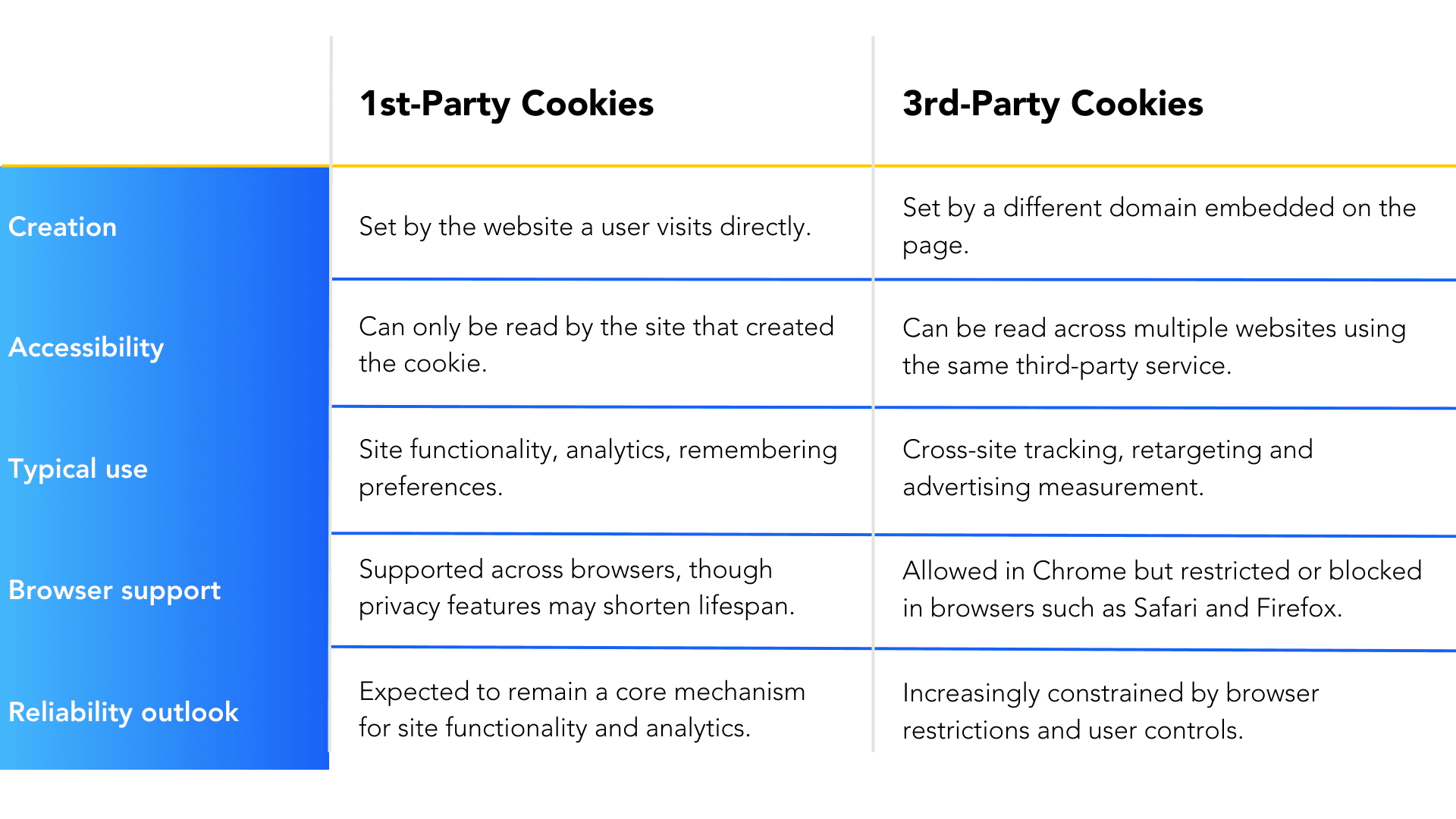
Several browsers, including Safari and Firefox, introduced restrictions to limit cross-site tracking years ago. Google explored alternatives and tested replacements, but ultimately cancelled its plan to fully remove third-party cookies from Chrome.
Even so, their usefulness has changed.
Industry sentiment reflects this uncertainty. In research by IAB Europe, the share of advertisers who said they felt prepared for a post-cookie environment fell from 78% in 2022 to 60% in 2024.
The result is a more fragmented environment where third-party cookies still exist but cannot be relied on consistently across browsers, devices or audiences.
Third-party cookies remain available in some environments, but their reach and reliability vary widely, making over-reliance risky for EMEA advertisers.
A strategy built entirely around cross-site cookies can quickly lose visibility when audiences switch browsers or block tracking. Frequency management, attribution and cross-device recognition all become harder.
Many EMEA marketers are therefore shifting toward more durable data foundations, including:
Together, these approaches create a more stable foundation for recognising and reaching audiences in an environment where third-party cookie signals are no longer consistent.
The goal is not to abandon cookies entirely. It is to avoid depending on them.
Epsilon’s identity strategy was designed with this evolving environment in mind. Rather than relying primarily on third-party cookies, Epsilon’s identity graph is anchored in deterministic purchase data from real individuals across EMEA. This reduces dependence on browser-level tracking while providing a more stable foundation for recognising and reaching audiences, without depending on cookie availability.
As browser policies and privacy expectations have made cookie-only approaches less dependable, identity strategies built on durable consumer signals have become increasingly important.
Epsilon also maintains direct relationships with more than 5,000 publishers, enabling advertisers to:
Because this approach is built around durable identity rather than a single tracking method, it remains effective whether third-party cookies are widely available, partially restricted or further limited in the future.
In a landscape where cookie signals are increasingly constrained, recognising real people across channels becomes the foundation for more consistent marketing performance.

