
Blog
Data clean room vs. data warehouse: What's the difference and why you need both
Learn more


The average person subscribes to at least four different streaming services—how are marketers reaching them across those platforms and channels?
Many media plans are still built on static assumptions, incomplete signals and outdated customer information.
In this webinar, Gillian MacPherson, Epsilon's SVP of Product Management, and Shannon Fazendin, the VP of PMX Lift, walk through Epsilon Pulse research about how people consume media today to see how brands can show up in the moments that matter by using consumer-centric, relevant insights—and leaving bad data behind.
Watch the full webinar to understand why audience-first planning is critical to breaking through the noise and how to reach customers effectively across channels.
MacPherson and Fazendin speak to the four main challenges they’re seeing in the industry today, including challenges with linear spending, outdated audience strategies, a complicated channel landscape and measurement limitations.
The first challenge Fazendin and MacPherson address is about linear spending.
Many brands have cut back their linear budget even though consumers still have an appetite for linear, with one in four saying they would consider getting cable if streaming got too expensive or if there was a special discount or promotion.
“While linear has declined, it's not dead yet,” MacPherson says. “[So] how do you make sure you’re not running away from something that still has a decent amount of eyeballs attached to it?”
MacPherson then shared the chart below that highlighted the split of cable versus streaming by content type, including sports, TV shows, movies and news.
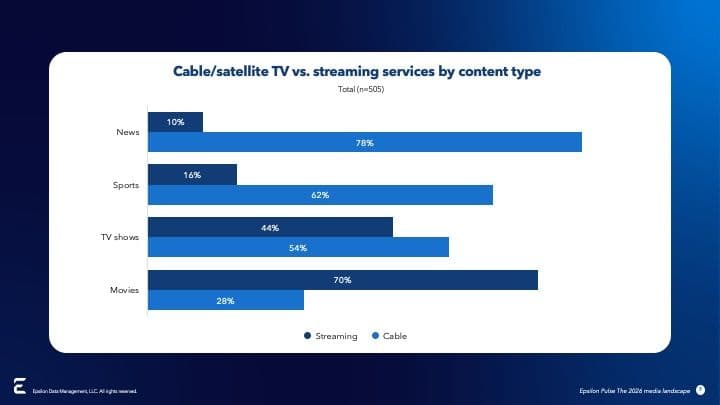
She also notes the interest in cable adoption, especially if cable gets too expensive, and that cable is ranked as the third most essential subscription behind Netflix and Amazon Prime Video.
Second, MacPherson and Fazendin discuss outdated audience strategies.
Brands have historically relied on demographic information, but that’s not enough today.
“It sounds great to take an addressable approach … but how do you really ensure you’re tapping into the right partners and utilizing the right strategy to ultimately achieve that performance and KPI you’re looking for?” Fazendin shares.
To evolve your strategy, MacPherson and Fazendin say that brands need to scale first-party data with lookalikes, evolve their targeting strategy and leverage purchase-based targeting.
“With so many new streaming services, some are being acquired by others, some are brand-new to the space—it’s a constantly evolving space—how do you navigate that, and how do you manage your buy appropriately?” Fazendin says.
And she’s right—consumers have more than 4.7 subscriptions on average, making the current channel landscape more fragmented than ever. In addition, nearly all consumers use multiple devices when they watch TV, so how are marketers supposed to adapt?
MacPherson highlights the current top five channels used to watch shows, movies, sports and news and how it varies across generations.
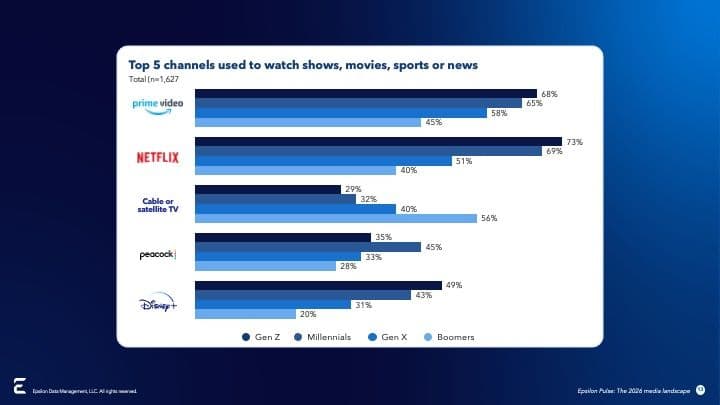
She also shares that it’s really a two-part problem: channel diversification paired with double-screening behavior.
“[On one hand] you have the channel diversification—if I’m a marketer, where do I put my dollars?—and then on top of that … consumers have multiple devices going,” MacPherson says. “They’re on social media, they’re texting, and—the good news—they’re shopping.”
“There’s been a lot of evolution in the technology and what partners are able to offer you in this space in terms of navigating all of that at the holistic level, hitting one household with an impression, and then, what would’ve been a duplicate impression, being incremental reach to a net-new household, right, so that’s key,” Fazendin says. “There are capabilities and partners in the marketplace that you can lean on for making those dollars work harder.”
The final challenge MacPherson and Fazendin discuss is limitations when it comes to measurement.
Due to the pressure brands are facing, basic delivery metrics like reach, impressions, media efficiency and frequency aren’t enough anymore.
“There’s more pressure on measurement than ever before,” Fazendin says. “I think the capabilities are out there and the partners in this space have really come a long way.”
They recommend that brands shift toward a holistic approach to measurement by challenging their vendors and partners, looking at performance across channels and measuring what matters.
While all these challenges are tough to solve, MacPherson and Fazendin recommend a four-pronged approach: evolving linear spend to meet the demands of today, leverage advances in targeting, stretch every media dollar to make it count and take a holistic approach to measurement. And if you want more support in your evolution, a partner like Epsilon can help you get there even faster.
Watch the full webinar for their in-depth recommendations, stats from the research and a Q&A moderated by eMarketer.
Choose a suggested prompt to keep going after reading

