Programmatic advertising today has evolved far beyond buying banner ad impressions.
In 2026, the only programmatic approach that consistently grows revenue is built on person‑level identity, privacy‑safe data and AI—so you can recognize real people across channels, reach more in‑market customers and prove the incremental impact of every impression.
This guide covers the basics of what programmatic advertising is and how it works, as well as the technological foundations you need to succeed.

Programmatic advertising is the use of data and technology to buy, sell and optimize digital ads in real time. Programmatic advertising serves relevant ad impressions to specific audiences in milliseconds through automated, data-driven processes.
According to Epsilon personalization research, 76% of respondents say they view brands negatively when they include inaccurate information about them in their advertising. Yet, 91% still see irrelevant ads daily.
Programmatic advertising powered by data, identity resolution and AI helps brands deliver precise, highly relevant ads. The technology automates decisions about who to reach, where, when and with what message, eliminating the inefficiencies, wasted ad spend and manual processes of traditional media buying.
Reaching people on their preferred channels and devices opens the door for more meaningful, personalized conversations. And, if you can reach them at the right time by understanding their habits or anticipating their wants and needs, you develop deeper affinity and connection.
Integrating programmatic advertising across the omnichannel customer journey helps to increase customer acquisition, improve customer retention and reengage lapsed customers—contributing meaningfully to business outcomes.
Programmatic advertising delivers precise targeting and greater campaign efficiency, ultimately improving ad performance and ROI.

Most programmatic campaigns center on a few core channels that match how people actually consume content across their day: video, display and audio.
Programmatic video advertising uses automated buying to place video ads across connected TV (CTV), online video (OLV) and other streaming environments in real time.
Video uniquely suits users’ preferences for snackable content and their tendency to multitask on their devices—but it also serves as a connection point to people who are locked in to long-form content (binge session, anyone?). And with its engaging, captivating and often entertaining appeal to consumers, video is the standout leader in today’s programmatic campaigns.
Programmatic display advertising uses automated buying to deliver banner, native and rich media ads across the open web wherever people browse, read and shop. Brands rely on display for efficient reach and retargeting, using audience and contextual signals to stay present with prospects throughout their daily journeys.
Programmatic audio advertising extends programmatic buying into streaming music, podcasts and internet radio. Audio is particularly useful for reaching people during commutes, workouts and other off‑screen moments. Advertisers use it to add an always‑on “voice” to their campaigns, reinforcing messages from video and display with targeted, interruption‑light audio spots.
Imagine streaming your favorite TV show and you hit a commercial break. A personalized ad for your local hardware store instantly plays on screen. How did that ad find you—in less than the blink of an eye?
As you watch, click and scroll, DSPs, SSPs, ad exchanges and other advertising technologies are executing complex auction negotiations to put the right ad in front of the viewer.
Let’s break down the process (and those acronyms).
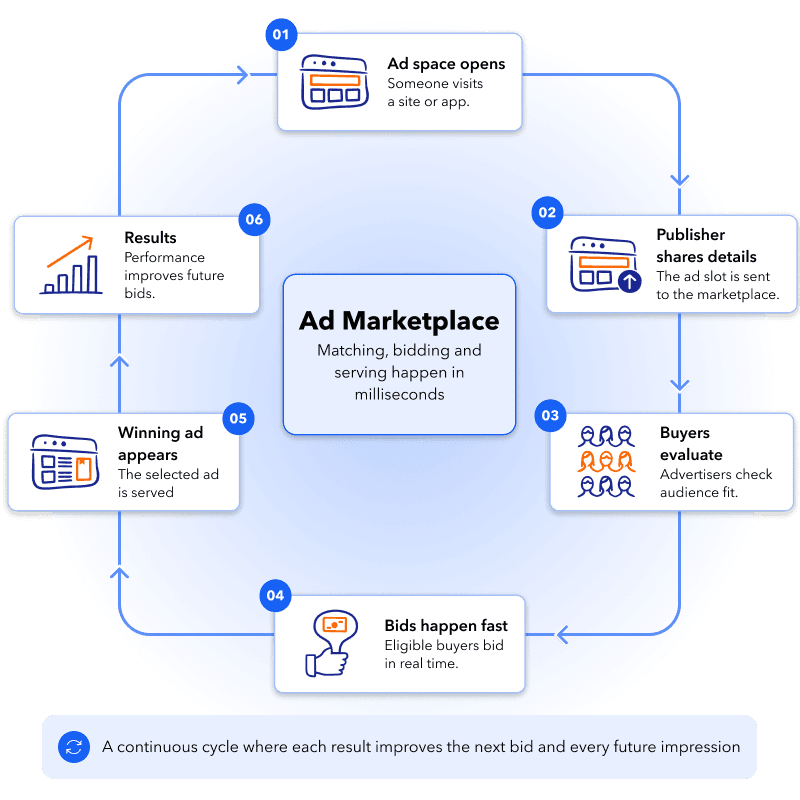
In as little as 100 milliseconds, you’re served an ad. By comparison, the blink of an eye is roughly 300 to 400 milliseconds—that’s an impressive feat of computing.
Many brands run paid, owed and earned channels as separate entities—with separate teams dedicated to paid media, website management, loyalty program strategy, etc. But consumers live across all channels and consume all types of media.
To create a cohesive, unified customer journey, your programmatic ads must be integrated across channels and with the rest of your marketing efforts.
Imagine you see an ad for a new brand on CTV, click a retargeting display ad later in the week, and then receive an email with a personalized offer a day after that. You finally convert by making a purchase on the brand’s website. In this instance, you experienced a coherent journey instead of a series of disconnected campaigns.
Synchronizing messaging across paid, owned and earned channels has enormous benefits.

Many advertisers ramp up their programmatic media spend and impressions in the hopes of acquiring new customers. But increasing spend in walled gardens like Facebook, Amazon and Google often leads to wasted budgets and disappointing results.
This is what we call the advertising “Hot Zone.” Customers here are easy to find, but they’re aggressively over-messaged (because every advertiser can reach them).
“Consumers actually spend more time on the open web versus inside walled gardens,” explains Karissa VanHooser, Vice President of Product Marketing at Epsilon. “When we look at where marketers are spending their money, it's backwards.”
The key to escaping the “Hot Zone” is connecting with high-value customers, not just easy-to-reach customers:
Every dollar you spend should go toward your best customers—not just the people you can easily reach.
The Real Deal on the Advertising "Hot Zone"
The key to escaping the “Hot Zone” is connecting with high-value customers. Learn where they are and how to reach them from Karissa VanHooser, Vice President of Product Marketing at Epsilon.
To deploy successful programmatic ads that reach real people with an omnichannel experience, you need to start with a foundation of first-party data, identity resolution and artificial intelligence (AI).
First-party data is your most important asset in any programmatic campaign. The first step in working with a new digital media partner is onboarding that data—connecting it to an identity solution for analysis and activation.
A “match” occurs when the onboarder can connect your brand’s CRM data to an individual in their identity graph. But there are two problems with the typical approach to matching:
You need a solution that goes beyond basic match rates and actually grows your addressable audience, including:
Talking to real in-market customers with wallets makes all the difference in your programmatic campaigns. Messaging devices, cookies or emails can lead to over-messaging consumers and significant wasted spend. A large auto manufacturer, for example, lost over $200 million in a single quarter because of over-frequency.
Epsilon research shows consumers don’t love ad repetition, either—88% of consumers notice repetitive ads, and 71% report being annoyed or extremely annoyed by repeated ads.
The best programmatic solutions offer robust, people-based identity resolution that serves ads to real individuals. It’s also imperative that your solution connects online and offline purchases so you can track each customer’s full journey and update their in-market status based on behavior. This allows you to optimize ad frequency, reduce wasted spend and improve campaign efficiency.
Predictive AI helps marketers connect with in-market consumers in a relevant, non-repetitive way that they appreciate. The best programmatic advertising technologies use predictive AI to understand exactly which individuals are most relevant for a brand, rather than going after a broad audience or segment, making real-time recommendations on:
The same AI technology should also drive omnichannel optimization—selecting the right channel (CTV, online video, display, audio) and the optimal time to deliver an ad impression. Over time, the best solutions use AI to optimize campaigns based on clients’ objectives (conversion, budget, reach, etc.) through real-time modeling and scoring throughout the life of a campaign.
A high-performing media buying solution helps you to successfully manage integrated campaigns, use your budget wisely and maximize your digital advertising ROI. Learn how to “look under the hood,” to ensure you get what you need.

Getting programmatic right isn’t just about turning on a platform—it’s about putting the right foundations, guardrails and feedback loops in place. These best practices help you define clear goals, find the right audiences, deliver relevant creative and continuously optimize in a privacy-safe way so every impression works harder for your brand.
The Real Deal on personalizing creative at scale
AI-powered dynamic creative optimization (DCO) can transform your marketing from generic messaging to truly personalized experiences. Learn how from Stacy Ward, SVP of Creative at Epsilon.
Epsilon's Chief Analytics Officer, Loch Rose, explains, “Many have tried to use clicks for attribution because clicks don’t require identity. But the problem is that clicks are a very limited form of attribution.”
Traditional digital advertising metrics like CPM, impressions and clicks still serve a purpose, but if you’re serious about understanding true campaign performance, it’s time to think bigger. There are variety of ways to meaningfully measure programmatic performance, but these are the top metrics to master:
Learn how to move beyond surface-level numbers and measure what actually matters to your business.

Programmatic advertising is only as good as the outcomes it delivers. These examples show how brands are using Epsilon’s identity, data and AI to turn strategy into measurable results—from reaching in‑market shoppers with audio to scaling personalized creative that lifts revenue.
Epson, a multinational electronics company, wanted to build a connected campaign for its EcoTank printers. The company sought to reach in-market shoppers in the moments that matter across screens and inventory—so it integrated programmatic audio into its existing CTV, OLV and display ecosystem. As a result, Epson reached 11 million unique individuals with an 88% audio completion rate (10% above industry average).
A national lifestyle and apparel brand wanted to drive awareness of its clothing lines while landing new customers, which meant increasing its investment in a mix of upper-funnel channels and audiences.
After more than doubling its investment toward upper-funnel tactics, including a major increase in connected TV investment, the retailer wanted to reach qualified prospects.
With Epsilon Digital, the retailer used first-party data to model audiences from its existing site visitors and buyers, excluding current buyers, to maximize reach against competitors and those new to the brand.
Epsilon Digital brings together person-level identity, privacy-safe data and predictive AI so your programmatic advertising can consistently reach real people across channels—not just impressions.
By activating your first-party data through Epsilon Digital, you can find more in-market customers, limit wasted spend from over-frequency and prove the incremental impact of every impression on revenue and loyalty.

Meet the programmatic advertising solution that reaches unique customers others simply can’t—including valuable Apple device users and your offline customers.