
Blog
Why the usual loyalty tactics won't work for Gen Z
Learn more

For loyalty technology to be effective, it needs to adapt alongside the people it serves.
When someone walks into a store and opens the app, it should recognize their location, offer available rewards, as well as personalize the content they see. If they write a positive review or refer a friend, it should acknowledge their advocacy appropriately and curate select experiences based on their engagement.
A layered loyalty tech stack is what makes this possible. It's the place where customer data, loyalty logic, personalization and engagement work together for seamless customer journey orchestration.
An industry-recognized customer loyalty platform can help you create an architecture that works for your brand. Moreover, it can give your brand the flexibility to meet changing customer expectations, scale across channels and markets, and continuously improve your loyalty program.
In this blog, we explain why the right loyalty technology matters, detail the different components that work together, outline the different loyalty tech stack approaches, share a checklist you can use to assess your current technology and how your brand can achieve better outcomes.
For years, brands approached customer loyalty as a rewards structure where people joined their program to earn points. But in 2026, nurturing loyalty means thinking beyond managing rewards to activating customer relationships.
Epsilon Pulse loyalty research indicates that 80% of consumers like it when brands personalize their communications based on their interactions and loyalty status with the brand. But personalized experiences are only as seamless as the technology that supports it.
In today’s environment, brands have to contend with AI reshaping product discovery and impacting purchasing decisions, customer expectations shifting toward personalized, real-time experiences and new engagement channels continuing to emerge. Yet many brands are still relying on their current platforms—designed to track points, tiers and transactions—to keep up.
As markets continue to evolve, brands need omnichannel loyalty technology that can activate their first-party data to improve targeting, identify lookalike audiences and personalize media across channels.
That’s where loyalty technology enters the picture. Rather than being something customers join for rewards, it turns loyalty into something brands actively reinforce.
Whether a brand’s goal is to increase purchase frequency, deepen engagement, encourage advocacy or strengthen long-term relationships, a strong loyalty tech stack shapes behavior—influencing the decisions customers make over time.
When someone abandons their cart, you can now see if they’re a high-value customer, predict the chances that they’ll convert, decide if they need a nudge to complete the action and trigger the most appropriate follow-up journey. An omnichannel loyalty stack validates customer behavior.
It organizes loyalty capabilities, so they happen with seamless ease. Data, decisioning, personalization and activation all work together in real time to deliver value, boost satisfaction and create hyper-personalized customer experiences.
It's important to understand the distinct role of each layer, how they work together and how first-party data flows through each component to make your loyalty experiences come to life.
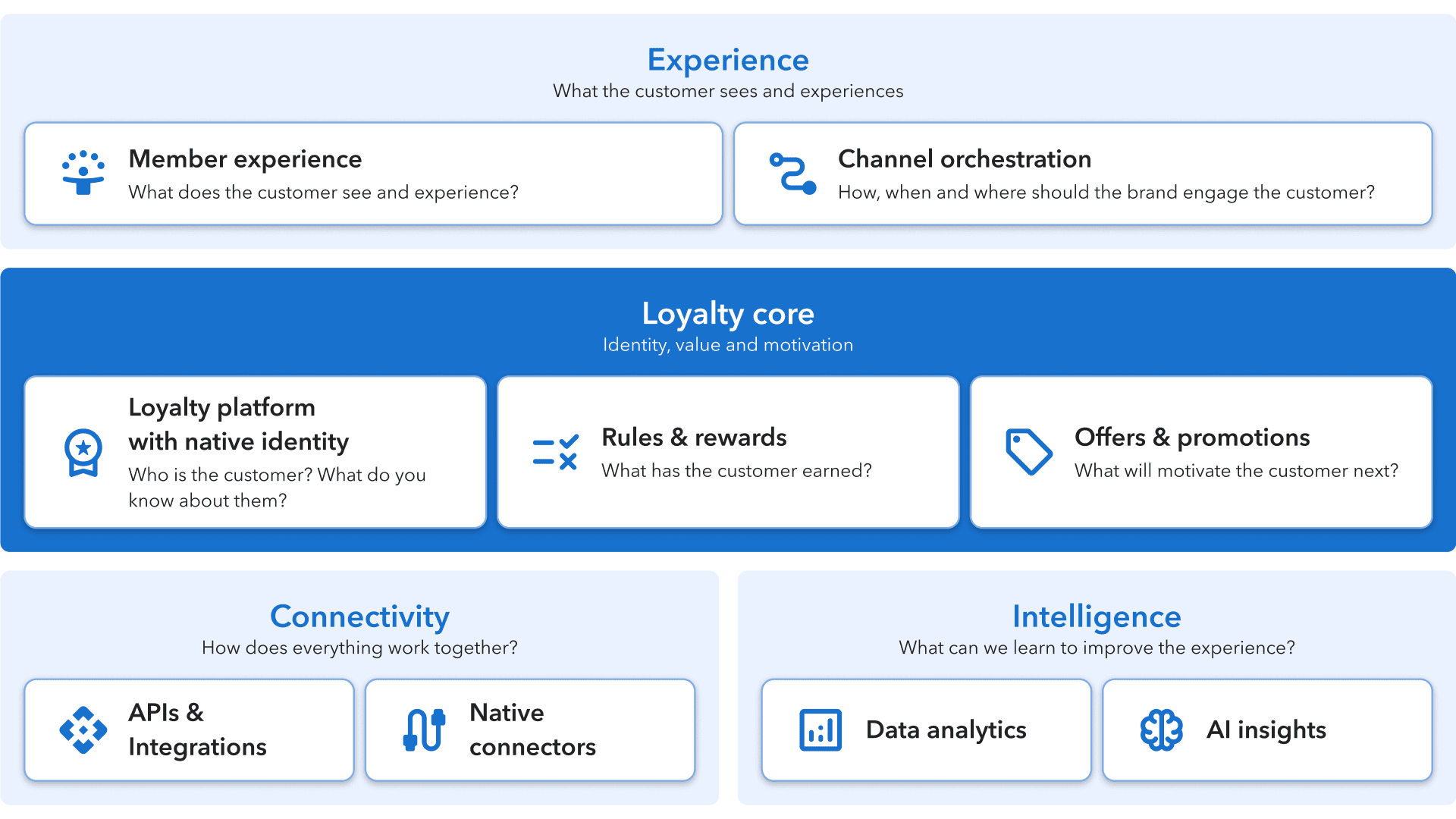
Figure 1. The architecture of a modern omnichannel loyalty tech stack. The right stack connects member experiences and orchestration with a loyalty platform, identity, rules, rewards and promotions, API integrations, native connectors and intelligence capabilities such as data, analytics and AI insights to deliver connected customer experiences.
A loyalty platform already knows who your customers are. If they shop online, buy in-store and click an email, the platform knows these interactions all belong to the same person. Because identity is built-in, every action maps back to the right customer profile. The biggest benefit of this layer is that it provides a holistic customer view, ensuring loyalty experiences are consistent wherever they engage.
With a complete view, the rules and rewards engine decides what should happen because of the action they’ve just taken. It’s the decision-making layer, applying the brand’s loyalty program logic and evaluates what members earn, unlock and experience. For example, if someone spends $125, they get free shipping. Points, tiers, missions, gamification and redemption logic are calculated automatically at this level.
If the first two layers are about recognition and fulfillment, offers and promotions management is responsible for how to influence and engage loyalty members. It motivates future behavior by creating, targeting and delivering offers and promotional campaigns. Because this layer is designed to guide customers to the next-best action, marketers can use personalized offers, discounts and limited-time promotions. Messages like, “Spend $75 this week for double points," have been executed at this layer.
Channel orchestration coordinates cross-channel engagement so customers can feel like they’re experiencing one connected journey. At this layer, the right message is sent at the right time, to the right customer. If offers determines what the customer receives, the channel orchestration layer decides to send the offer by email or push notification; knows the offer was redeemed online and stops the reminder; and asks what the next best action is. Channel orchestration coordinates the member journey.
This layer is the only one the customer actually interacts with. It’s where members directly interact with the loyalty program and includes the loyalty dashboard, rewards wallet, member portals and mobile loyalty program apps. Unlike the other layers, it doesn’t make decisions about the loyalty experience, it displays them. Essentially, it’s where the decision-making from other layers is made visible and interactive to the customer.
While the other layers take action, the data and analytics layer touches everything across the tech stack and leverages that loyalty data as insight—so program managers can adjust their strategy. Loyalty program performance metrics, member engagement analysis and campaign performance all live in this layer. Marketers can spot trends, identify opportunities and get a better understanding of what’s working and why. It ensures you can improve ROI and make data-driven decisions.
The integration and API is the layer where everything else your brand uses communicates with the rest of the environment. Simply put: it shares information, including APIs, data connectors and partner integrations. This layer allows your first-party data and loyalty actions to run across channels and systems without interruption. In the loyalty engine, integrations and APIs run across the entire tech stack, making the whole thing operate in real-time with each business function. The layer provides flexible connectivity that brands can use to adapt to emerging technologies as their needs evolve.
An advanced loyalty tech stack recognizes customers, determines rewards, tailors offers, orchestrates member journeys and measures loyalty program performance—leveraging unified first-party data as the connective tissue that powers each layer.
Years ago, loyalty programs consisted of straightforward, transaction-based interactions that happened all in one place. Today’s customer journey is less linear and even less predictable.
Before a customer makes a purchase, they might browse in-store, add an item to their cart on a website, redeem points in the app and then open an email. While the customer views this as one brand experience, these moments occur across different systems, teams and channels within your brand.
Ever-emerging digital channels have shifted customer behavior and increased the expectation that brands provide a connected experience that moves with fluidity across touchpoints.
But loyalty hasn’t fundamentally changed—what it takes to build it has. Brands must recognize members consistently across channels, maintain a real-time customer profile and synchronize loyalty status, rewards and offers regardless of where interactions occur.
Without a solid data strategy and identity resolution, the customer view is fragmented. With unified data, identity resolution continuously reconciles disparate interactions across channels, devices and systems into a single trusted customer profile.
Nurturing loyalty in the moments that matter requires a technology stack with a strong data foundation, identity resolution, channel-agnostic rewards management and powerful decision-making capabilities that fuel engagement across touchpoints. A layered loyalty tech stack is designed to integrate, scale and evolve independently while delivering a unified customer experience.
One size doesn’t fit all—for loyalty programs or the tech that powers them. It’s important that your unique vision for building loyalty is enabled by a system that supports your strategy.
Brands have three options: build a tech stack in-house with custom capabilities, implement an integrated platform or assemble a best-in-class system from advanced technologies. The right structure will depend on your size, brand strategy and the complexity of the markets you serve.
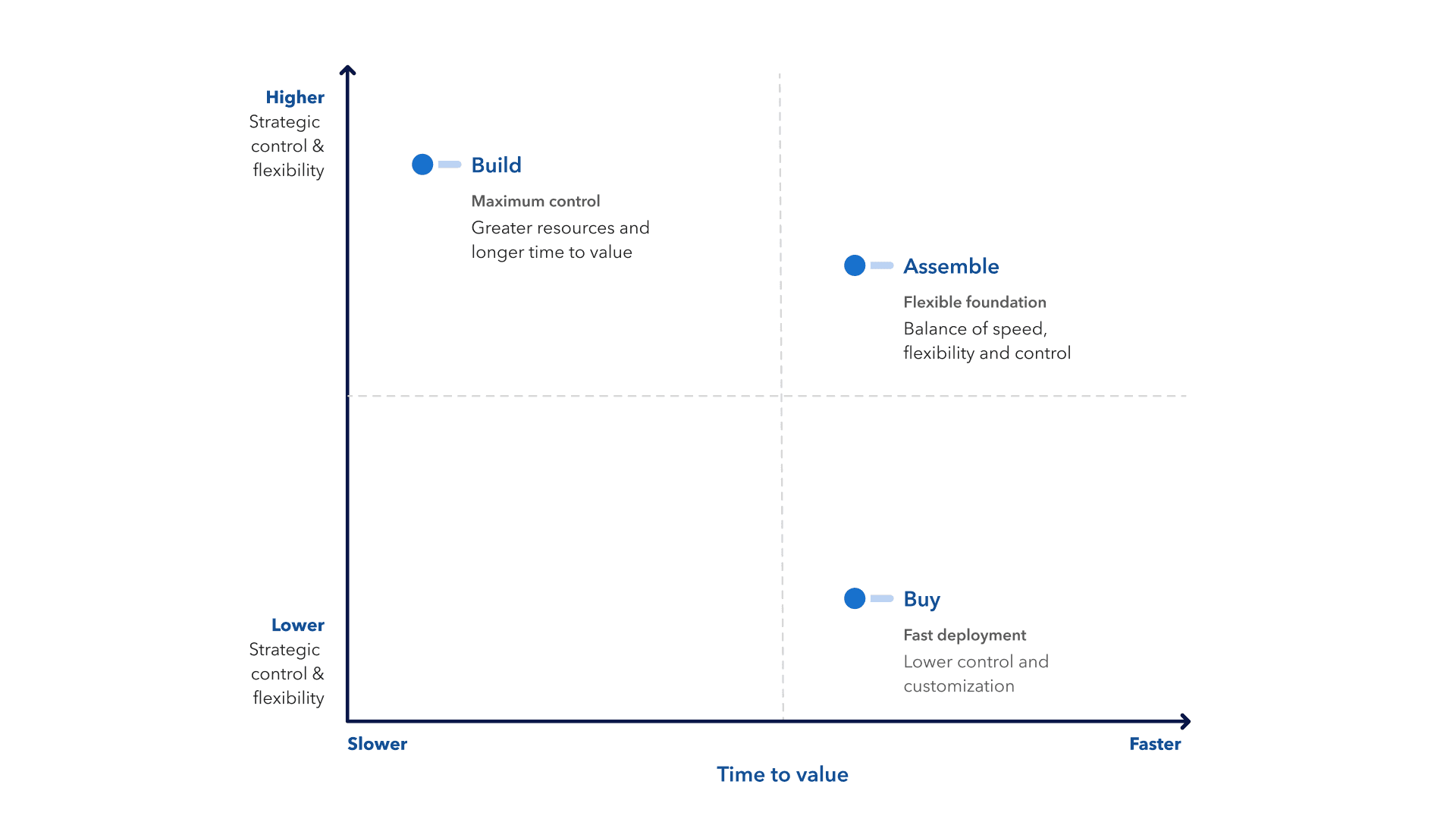
Figure 2: Choosing the right loyalty technology approach—build, buy or assemble—based on your loyalty strategy, business resources and goals.
After choosing the right loyalty tech stack structure for your brand, it may be helpful to ask the following questions before investing in technology.
| Question | If your answer is "yes" |
|---|---|
| Are loyalty experiences a competitive differentiator for your brand? | Building or assembling will offer greater flexibility. |
| Do you adjust your program design frequently? | Look for a platform that’s configurable or composable. |
| Do you have sizable engineering resources with advanced expertise? | Building or assembling is a viable option. |
| Is deployment within six months mission-critical? | Consider buying—it’s the fastest path. |
| Does your loyalty program need to operate across brands or regions? | Make sure the solution can accommodate multi-brand and multi-market requirements. |
| Are your current platform integrations complex? | Focus on platforms with strong APIs. |
The right customer loyalty platform is the foundation for nurturing loyalty and building life-long brand advocates. Invest in technology that aligns with your brand strategy, can meet customer expectations and has capabilities that can deliver personalized experiences at scale.
1. Identity resolution ensures that the same person doesn’t have three different member profiles. When your customers shop online, use mobile apps and make an in-store purchase, it recognizes each individual across all channels.
What good looks like:
2. Real-time time processing allows your brand to instantly recognize members and offer them value in the moments that matter. Batch processing takes more time—updating interactions intermittently (every hour, overnight, daily), leaving customers waiting a designated period of time for their actions be acknowledged.
What good looks like:
3. Rules engine flexibility adapts to customer behavior ensuring marketers can adjust campaigns and manage loyalty logic within an easy, no-code environment.
What good looks like:
4. Channel coverage and orchestration depth ensures customers receive a seamless experience wherever they engage with your brand. It ensures your loyalty program connects and supports engagement on every channel.
What good looks like:
5. Data portability and ownership will ensure you can easily access or transfer your customer data throughout the ecosystem and retain ownership rights if you switch vendors.
What good looks like:
6. Privacy and consent infrastructure is critical for maintaining consumer trust. With it, brands can responsibly collect, manage and activate customer data while meeting regulatory and customer expectations.
What good looks like:
7. Scalability ensures that as the digital landscape evolves, you can adapt. The right loyalty platform supports shifts in customer behavior, transaction activity, market shifts, emerging channels and program complexity without compromising the experience.
What good looks like:
8. Reporting and analytics provide actionable insights that help brands optimize campaign performance and improve real-time decision-making.
What good looks like:
While the loyalty layers, system requirements and evaluation criteria impact how your platform is designed and how it operates, AI shapes how those features deliver. But before AI can produce the type of output that brands expect, you need to understand what’s required first.
Instead of evaluating AI as a feature, invest in a loyalty platform that’s built on a solid data foundation. When high-quality data sits at the core, each layer of an omnichannel tech stack can leverage AI to deliver its capabilities at scale—with greater precision.
With the clear view of customer behaviors, preferences and interactions, AI can personalize experiences, increase operational efficiency and improve decision-making. Because AI augments every layer of the loyalty engine, it identifies when members disengage, makes relevant recommendations, detects fraud in real time and allows marketers to optimize member journeys based on meaningful data.
To be effective, AI needs a loyalty platform with the right data to ensure members engage meaningfully with your brand.
Advanced loyalty program software evolves with your brand. Assessing your loyalty capabilities will help you identify capability gaps and prioritize the improvements that will help you build smarter loyalty experiences that resonate with your customers.
The right solution can make, or break, your loyalty strategy. Investing in a loyalty partner that combines quality data, identity resolution and advanced technology with hands-on expertise will help you drive measurable outcomes from setup to optimization—ensuring you get the most from your investment in any market.
Loyalty technology is a layered software ecosystem that powers modern customer loyalty programs. It typically includes identity resolution, a rules engine, offer management capabilities, channel orchestration, data integration and analytics to deliver personalized experiences across digital and in-person customer interactions.
A customer data platform (CDP) is a martech solution for known customer data that creates unified customer profiles by bringing together data from across the business. A loyalty platform builds on that foundation by managing loyalty-specific capabilities such as rewards, points, tiers, promotions and member experiences. A CDP knows who the customer is, while the loyalty platform determines how to engage and reward that person.
The best loyalty technology depends on a brand’s goals, existing technology stack and loyalty program strategy. Enterprise brands should consider platforms that have identity resolution, real-time processing, channel coverage, analytics, scalability, integrations and AI capabilities to ensure the solution can support long-term business growth.
Implementing a new loyalty platform takes 6 to 12 months, depending on the complexity of the program and existing systems. Most brands use phased rollouts by channel or region to reduce risk. One of the most underestimated parts of implementation is customer identity migration, which involves accurately matching and transferring existing member data into new platforms.
AI helps loyalty programs become more personalized, efficient and predictive. Common use cases include recommending the next best offers, predicting customer churn, personalizing rewards, detecting fraud, optimizing promotions and helping marketers deliver relevant experiences at the right time and through the right channel.


