
Blog
Golden Quarter: Why you should keep media running into January 2027
Learn more


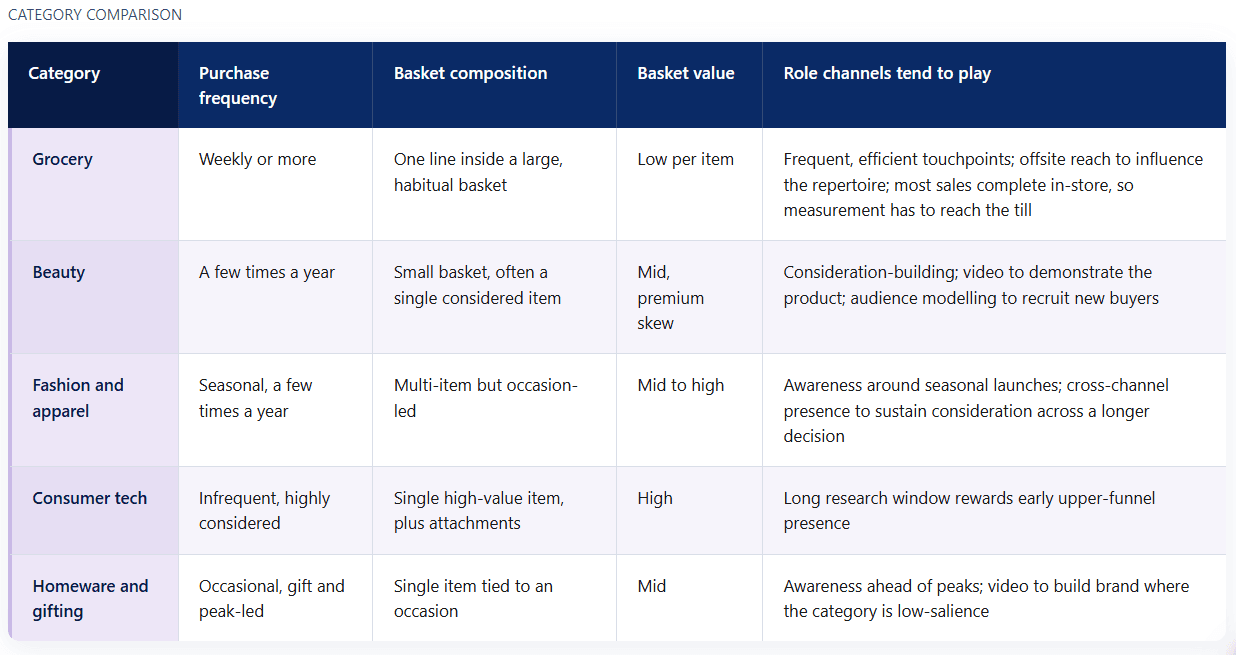
Media does not work the same way in every retail category. How often people buy, what they put in the basket and what that basket is worth all differ by category, and those dynamics shape the role each channel plays in a media strategy.
This guide does two things:
The same channel plays a different role depending on the category being sold, because shopper behaviour changes from one category to the next.
Three category dynamics do most of the work:
This is the planning frame. It describes how each category tends to behave and the role channels typically play as a result.
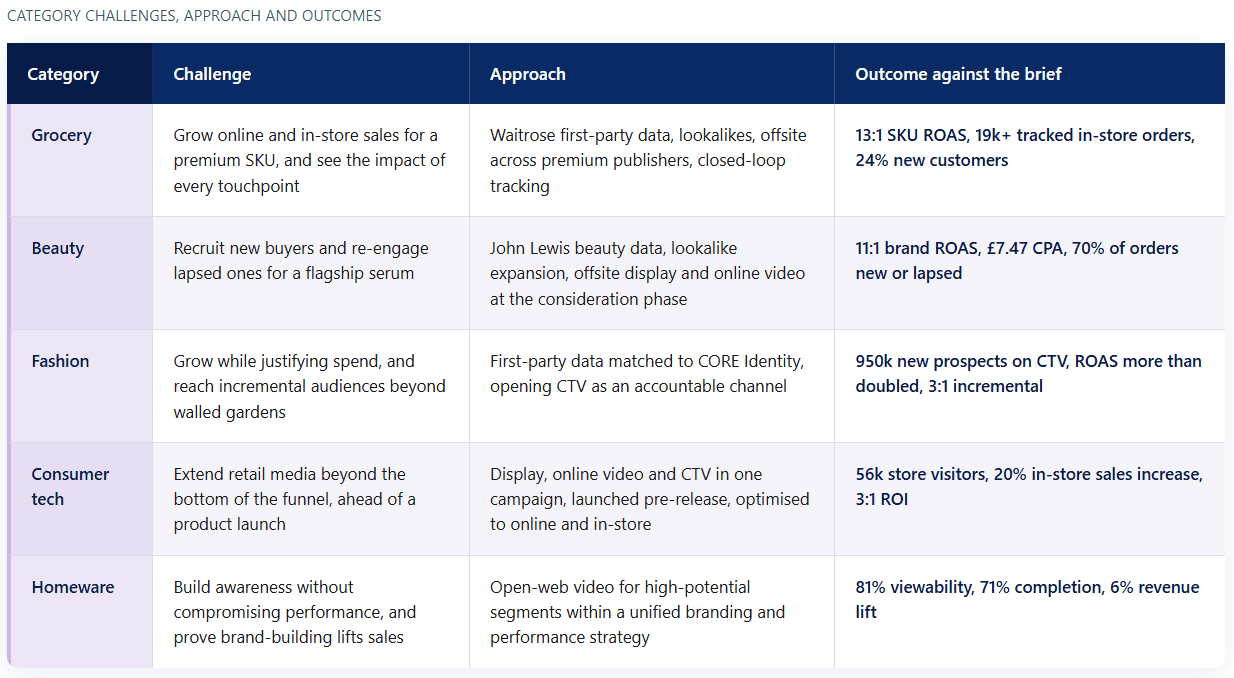
Each example below pairs a category with a real UK campaign, set out as the challenge the brand faced, the approach taken and the outcome achieved against that brief.
Grocery is bought most weeks, and any single product is one line inside a large habitual basket. That means an individual SKU is competing for a place in an established repertoire rather than winning a standalone decision, and the majority of sales still complete in-store. Channel strategy tends to follow: efficient reach while shoppers are thinking about food, and measurement that reaches the till rather than stopping at the website.
Challenge. A premium bakery brand wanted to grow online and in-store sales, and to track the full impact of every media touchpoint on the purchases that followed.
Approach. Waitrose first-party data was used to reach shoppers with a natural affinity for cooking, entertaining and premium experiences. Offsite activity across premium publishers engaged those shoppers as they explored mealtime ideas, with targeting built on modelled lookalikes of existing buyers, ongoing optimisation, and closed-loop tracking across online and in-store sales.
Outcome against this brief.
What this example shows: where a category completes most of its sales in-store, closed-loop measurement is what makes the return visible at all. Counting only online conversions would have missed the majority of this campaign's sales.
Beauty is bought a few times a year, usually as a small basket built around a single considered item at a premium price point. The purchase is a decision rather than a habit, so there is a genuine consideration phase to influence, and the product often needs to be demonstrated rather than simply listed. Basket value supports richer creative and audience modelling that goes looking for new buyers.
Challenge. A prestige skincare brand set out to drive renewed momentum for its flagship serum, recruiting new beauty buyers while re-engaging lapsed customers whose previous experience signalled affinity for premium formulations.
Approach. The strategy centred on John Lewis beauty data, shaped by online and in-store relationships, to reach shoppers genuinely invested in premium beauty. Lookalike expansion identified similar buyers, including those purchasing comparable premium brands. Audiences were engaged offsite through display and online video as they explored beauty advice, product benefits and skin suitability, supported by closed-loop conversion tracking.
Outcome against this brief.
What this example shows: with a recruitment brief, lookalikes seeded from the brand's best buyers reached genuinely new customers rather than recirculating spend among existing ones.
Fashion is bought a few times a year in seasonal bursts, with baskets that are multi-item but tied to an occasion, at mid-to-high value. Decisions play out over a longer window than grocery, and the recurring commercial challenge is reaching genuinely incremental audiences rather than paying to speak to existing customers. Connected TV suits the seasonal awareness job when the targeting can be held accountable.
Challenge. FatFace needed to keep driving growth while justifying marketing spend. CTV offered high-impact engagement but raised questions about frequency management, traditional performance channels were struggling to reach incremental audiences, and reliance on walled gardens brought audience and measurement transparency issues.
Approach. Matching FatFace data to Epsilon's CORE Identity gave a deeper understanding of the audience, opened CTV as a targeted and accountable channel, provided visibility of customer journeys from awareness to conversion, and addressed data compliance concerns.
Outcome against this brief.
What this example shows: when the brief is incremental growth rather than efficiency, identity resolution is what makes an awareness channel like CTV accountable enough to invest in.
Consumer tech is bought rarely and researched heavily, as a single high-value item often accompanied by attachments. The long research window means there is a real opportunity to build preference before the purchase decision forms, and the sale frequently completes in a shop. Channel strategy in the category tends to reward presence earlier than the bottom of the funnel.
Challenge. Currys saw an opportunity to extend retail media beyond the bottom of the funnel, engaging tech enthusiasts before and during product launches rather than only at the point of purchase.
Approach. The campaign marked two firsts: combining display, online video and CTV within a single campaign, and launching media before a television's release to generate anticipation before the product was widely available. Currys targeted high-end TV shoppers who had browsed the manufacturer's or a competitor's products without purchasing, using Currys first-party data and Epsilon's CORE Identity to optimise for both online and in-store sales. The work won Best Use of Retail Media at the Digiday Awards Europe.
Outcome against this brief.
What this example shows: in a category with a long research window, media running before the launch window and across several channels outperformed a single-channel approach against the same objective.
Homeware and gifting are bought occasionally, usually a single item tied to an occasion or a seasonal peak. Because the category is low-salience for much of the year, brands have to build awareness ahead of the moments that matter. The persistent difficulty is that awareness work is harder to connect to sales than demand capture, which makes it the first budget questioned.
Challenge. Cheerz recognised it needed to evolve its strategy to boost awareness and drive growth without compromising performance. Central to this was proving that brand-building activities could positively impact sales.
Approach. Already working with Epsilon on display, Cheerz expanded into open-web video with high-impact large-format ads aimed at high-potential segments including new parents. Epsilon built a unified branding and performance strategy, aligning messaging, formats and frequency, then compared audiences exposed to full-funnel branding and retention against retention-only activity.
Outcome against this brief.
What this example shows: a clean comparison against a retention-only group is what turned an awareness argument into a measured one for this brand.
The categories differ, and so did the briefs. Four things were nonetheless true across all five campaigns.
1. The audience was built from real first-party data. Every campaign started from retailer or brand first-party data, in several cases resolved to real people through CORE Identity, rather than from cookies or walled-garden proxies.
2. They ran cross-channel rather than single-format. Display, online video and CTV were combined according to the job in hand. Where it was tested directly, the combined approach outperformed the single-channel one.
3. Measurement was designed around the brief. SKU-level tracking, incrementality, cost per acquisition or a test-versus-control comparison were each chosen to answer that brand's question, not applied as a template.
4. The in-store effect was measured, not assumed. Where the category completes sales in shops, store visits and in-store orders were tracked directly rather than inferred.
These are observations across five campaigns rather than universal laws. They describe a way of working that held up across very different categories and objectives.
The useful question for a brand selling across several categories is not “which metric should I chase in each category” but “can I plan, target and measure each category the way it actually behaves.” That points at three foundations: first-party data and identity so audiences are real and privacy-safe, a channel mix that can flex from demand capture to connected TV as the category requires, and measurement designed around the brief, including the sales that happen in-store.
This is where Epsilon works with brands and their retail partners, combining CORE Identity, cross-channel activation across display, online video and CTV, and closed-loop measurement tied to online and in-store sales. The five examples above are that approach applied to five different categories and five different objectives.
Planning media across more than one category and want every campaign built on real audience data and measured against the objective that matters? Explore Epsilon's Digital advertising and Retail Media solutions or get in touch to discuss your plan.
What is a category specific media strategy?
It is the recognition that media plays a different role depending on the category being sold. Purchase frequency, basket composition and basket value differ by category, and those dynamics shape which channels do the work and when.
Do these campaign results apply to my category?
Not directly. Each result reflects the objective, brand, audience and timing of that specific campaign. They are worked examples of what an approach achieved against a particular brief, not benchmarks for a whole category. The transferable part is the method, not the number.
How does purchase frequency change a media strategy?
High-frequency categories such as grocery are bought habitually, so media tends to work as efficient, recurring presence. Infrequent, considered categories such as consumer tech have a long research window, which creates room to build preference before the decision forms.
Why does basket value matter in media?
Basket value sets how much media investment a new customer can justify and how much creative depth the category can fund. Low-value, high-frequency categories favour efficiency; higher-value categories can support video and awareness work.
What is the difference between onsite and offsite retail media?
Onsite runs on the retailer's own sites and apps and captures existing demand. Offsite activates the retailer's first-party audiences across the wider web, social and connected TV, and is used to build reach and recruit new customers.
Why does so much media value show up in-store?
Most retail categories still complete the majority of their sales in shops. In the examples above, grocery, beauty and consumer tech campaigns each drove measurable in-store orders or store visits. Closed-loop measurement is what makes that visible rather than inferred.

