
Research
2026 holiday shopping trends: The impact of holiday ads, AI use case shifts, the impact of rising costs and more.
Learn more


On paper, your loyalty program should be working. Sign-ups are climbing. Offers are going out. It’s doing exactly what it was designed to do.
But your customers tell a different story: quiet breaks in engagement that add up over time.
Let’s look at an everyday example: A customer gets an email offer for a product they’ve never shown interest in. They read the subject line without opening it.
Later, they’re scrolling an app and see an offer for an item they don’t want, again. Before long, they receive a steady stream of communications they ignore.
So what are loyalty programs actually building when relevance and engagement start to slip?
When customers repeatedly receive emails they ignore, skip past social posts and get unwanted offers, it adds up—undermining the very loyalty you’re trying to build. That’s experience debt in action.
Experience debt is the result of irrelevant, disparate or ill-timed interactions that accumulate over time and erode consumer trust in your brand. When siloed messaging, slow fulfillment and inconsistent journeys become the norm, it gradually undermines customer experiences and turns intended personalization into repetition.
Experience debt leaves brands wondering why customers disengage despite high membership. Here’s a simple view of how experience debt forms, builds and ultimately fragments the customer journey.
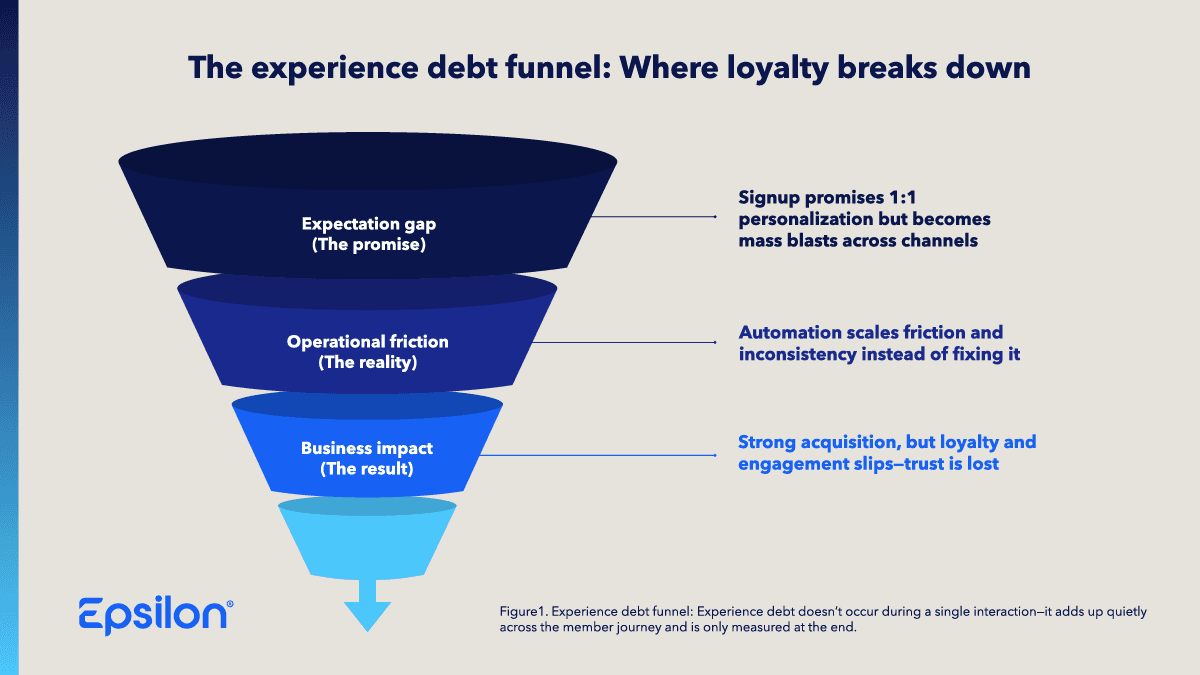
Loyalty programs are designed to build and strengthen customer relationships—delivering personalized experiences, boosting customer lifetime value and bolstering brand advocacy. Yet, all too often, they do the opposite.
Nearly 90% of people notice repeated ads, according to our research. But awareness isn't the problem, impact is. 84% say repetition makes them less likely to respond, and 76% say it makes them like the brand less.
It even spills over, with 65% saying it damages their perception of the platform—and by extension the brand itself. This is what experience debt does: breaks trust and weakens perception of the brand behind it.
Loyalty programs often step in as a way to patch over poor experiences, compensate for lack of recognition and force engagement instead of earning it. Because experience debt doesn’t happen in a single broken interaction, but through a series of irrelevant consumer-brand exchanges, loyalty programs tend to mask the problem instead of fixing it.
A missed interaction becomes an offer. A disconnected experience turns into a discount. Rather than analyzing customer journey stage, engagement and customer satisfaction, brands focus on what else they can offer.
You can send 100 emails promoting red shirts, if the customer isn’t interested, they’re still not going to buy one. Without a deeper customer understanding, brands default to the same unsuccessful tactics, making their loyalty programs feel transactional—more messages, restated, re-offered—even when customer behavior suggests it’s not working.
This repeated cycle is how experience debt grows.
At its core, experience debt comes from an incomplete view of the customer.
For many brands, different teams shape the customer experience, each with different goals—email, social, retail media—disparately optimizing for their own performance metrics. Each touchpoint tells its own story, and when teams operate in isolation, none of them connect or recognize they're talking to the same person.
That fragmentation shows up quickly.
When data and decision-making are split across teams, a customer’s data signals—what they engage with versus what they don’t—remains fragmented. This fragmented approach creates journeys where customers receive overlapping offers, conflicting messages and repetitive promotions.
That said, customer expectations are quantifiable, as our loyalty research shows: 89% of consumers want their loyalty brands to recognize them across channels, and 82% expect to be treated as returning customers.
Ultimately, what gets treated as separate—data, systems and teams—customers experience as one continuous brand experience. These disjointed moments turn loyalty into lowered expectations that lead to disenchantment, disengagement and lost customers.
Brands actively work to understand their customers better, repair lapses in engagement and personalize across channels. They invest heavily in advanced data and technology to better meet rising customer expectations.
According to IDC's 2025 Industry Insights Retail Survey, brand loyalty and customer retention emerged as the primary drivers of retailers' investments in personalized customer experience as a strategic business priority. In the same survey, 45% of retailer organizations found customer loyalty programs and rewards as key initiatives supporting these strategies. For retail loyalty software vendors, this confirms that loyalty platforms are now considered a strategic CX infrastructure. (Source: IDC Market Glance: Loyalty in Retail, 2Q26, #US54421326, published March 2026)
But investment, by itself, isn’t enough to resolve the underlying challenges.
Better outcomes are held back by fragmented customer data and identity across different teams and platforms.
While advanced customer data platforms (CDPs), clean rooms and loyalty platforms can see and predict customer behavior with unprecedented accuracy, different teams often own different parts of the same customer journey. When that happens, it reinforces the very gaps and fragmentation advanced tools are designed to eliminate.
When customer data is program-specific, for example, it becomes difficult to recognize a high-value customer that exists in a brand’s broader ecosystem as a top customer in its loyalty program. Essentially, even a world-class platform will struggle to create seamless experiences if processes and teams aren’t aligned.
People don’t connect to campaigns. They value brands that speak to them authentically at each touchpoint, recognize them on an individual level and actually understand their needs.
Brands that get this right aren’t the ones with the most technology, they’re the ones that effectively unify, activate and apply customer insights across the buying journey. Not in theory, but in practice.
Adopting a person-first approach means understanding customer behavior, creating an ongoing feedback loop and using those insights to create better experiences. Moving from isolated campaign execution towards a unified customer view requires orchestrated, experience-driven action and a dedication to continuous refinement.
That’s the shift. Placing the customer at the center rather than the product.
This allows brands to create a series on interactions that build on each other, recognize valued customers across touchpoints and foster loyalty through continuous, intentional experiences. Brands that put customers at the center outperform those that don’t.
A person-first approach builds brand affinity, increases engagement and boosts retention.
Customer-centric loyalty programs are essential to eliminating experience debt.
When someone joins a loyalty program, they actively choose to share their data. This creates valuable data signals, sharing what people value, how they feel and where they want to engage with your brand.
Establishing a continuous feedback loop is critical to creating better experiences because it provides a rich view of customer behavior and sentiment in real-time. This healthy cycle is how loyalty transforms from a program into a foundation that fuels meaningful experiences.
Working with an industry-recognized loyalty provider can help brands drive coordinated loyalty initiatives that seamlessly integrate across platforms. Data-driven loyalty—built on a —gives brands a connected approach, a solid data strategy and expert-level program support.
Epsilon’s loyalty closes the gaps that prevent brands from delivering the right message at the right time, across channels. It ensures your first-party data unlocks rich insights and offers advanced, AI-driven capabilities that align with your brand strategy.
A strong loyalty partner ensures your consumer-brand interactions minimize experience debt and build lasting relationships, not transactions.
The path forward is not collecting more data and relying on the latest technology. It’s having the right playbook, the right tools and the right loyalty provider.
With a holistic view, experience debt can’t take root: brand notifications stop repeating, messages stop colliding, and experience debt diminishes. When customer data and decisions are connected, your interactions are consistent, relevant and valuable.
Epsilon Loyalty brings disparate data and teams together—linking identity, insight and execution for a unified view that serves as the connective tissue across the entire customer journey.

Shamba Schmidt is a Vice President of Sales Solutions Consulting at Epsilon.


