
Blog
Data clean room vs. data warehouse: What's the difference and why you need both
Learn more


How people search, shop and engage with brands has been transformed by digital technology, but the goal for businesses has not. Earning customer loyalty remains a fundamental driver for long-term growth.
The reason is simple: Loyal customers create disproportionate value. According to research, loyal customers spend an average of 67% more than new customers, and a 5% increase in customer retention can boost profits by 25% to 95%.
But attracting loyalty—and retaining it—is the challenge facing most brands today. With factors like third-party cookie deprecation, evolving privacy regulations and changing consumer expectations, the question is no longer whether loyalty matters—but how to earn it.
The solution lies in first-party data marketing.
Prioritizing customer loyalty data is one of the most effective ways to build sustainable growth. A customer loyalty provider, built on a solid data foundation, can help you consistently deliver valued experiences, earn consumer trust and create personalized experiences that keep customers coming back.
In this blog, we’ll explore what first-party data is, why it has become essential for customer loyalty and practical ways brands can use it to create personalized experiences that increase retention, engagement and customer lifetime value.
Loyal customers will stand in line, spread the word about your products and consistently choose your brand above the rest. In return, they expect experiences that meet their expectations, recognize their needs and provide value.
In fact, customers believe it’s worthwhile to share data when they get value back. According to research, 83% of consumers are willing to share their data to receive a more a personalized experience.
This creates a significant opportunity for marketers. Instead of relying on data from external sources, they can use the information people are willing to share with them directly: customer loyalty data.
Customer loyalty data is the first-party data that people share directly with brands through loyalty programs and other consumer-brand exchanges, including purchase history, reward activity, engagement, preferences, demographics and behavioral patterns. As third-party cookies continue to disappear and consumer privacy expectations grow, loyalty marketing data is becoming more vital, giving marketers a deeper understanding of their customers.
Loyalty programs hold the unique ability to collect data directly from customers who have chosen to engage with your brand, making it more accurate, actionable and privacy compliant. Whether your program is points-based, tiered or gamified, loyalty programs reveal what people buy, which offers they redeem and the channels where they’re most likely to engage.
But, regardless of the loyalty program model, each type creates opportunities to collect data as a direct result of interactions with your brand. Ultimately, the more people engage with your loyalty program, the more you know about them.
Brands with a solid first-party data strategy, can turn their loyalty data into actionable insights. When brands use data effectively, they gain a competitive advantage because they are better positioned to identify high-value customers, predict future purchasing behavior and personalize communications across channels.
With better customer loyalty insights, you can build lasting relationships, increase customer lifetime value and differentiate your brand in an increasingly competitive marketplace.
Think of data as pages of a story. In that way, data helps you understand what’s happening with your customers.
Each interaction—a website visit, a purchase, a review—is another data plot point. When those moments are connected, it provides context around where the customer has been, what they value and what they want next.
What makes customer loyalty insights so powerful, is their ability to reveal each customer’s journey and the motivations driving them. That’s what truly puts the customer at the center: not simply gathering customer data, but using data to understand the person interacting with your brand.
Zero-party data is information that a customer willingly and intentionally shares with your brand. Examples of zero-party data include communication preferences (email over text), favorite products or brand categories and survey responses.
Put simply, it’s what people choose to tell you about themselves. Because this data is voluntarily given, it gives marketers direct insight into what customers want and need.
Rather than relying on assumptions, or trying to interpret, you can make data-driven decisions that indicate you’ve listened to the voice of the customer by actively shaping experiences that matter to them.
Unlike zero-party data, which customers intentionally share, first-party data is gathered when a customer completes a transaction. This type of data reveals actions your customers take, including what they buy, where they shop and how they spend.
For example, data directly from credit and debit card transactions, returns, subscriptions and payments are different forms of transactional data. Each of these data sets provides a snapshot of key decisions your customers make and signals what happened in that customer’s journey.
With these insights, you can more accurately target high-value customers, reengage lapsed customers and increase customer loyalty over time. Ultimately, transactional data shows you what’s happening in the customer’s story, ensuring you can measure loyalty and optimize future interactions.
If you think of transactional data as what customers do, behavioral data is how customers behave. Think of first-party behavioral data as answering the question: how did the customer arrive at the point-of-sale?
Website visits, products viewed, email opens and clicks are all examples of behavioral first-party data. This type of data reveals how someone moves through the customer journey, before during and after taking an action.
Behavioral data reveals their choices, interests and engagement patterns. These insights help brands predict future purchases, identify churn and create personalized experiences that are based on actions that reveal their motivations.
Behavioral data shows the path to purchase—what customers explore, what grabs their attention, how they engage—unlocking rich insight into the journey behind their decisions.
Before marketers can fully understand the customer journey, they must know who that journey belongs to. This is where identity and profile data come into play.
This type of data includes loyalty ID, email addresses, household information and demographic details. Consequently, identity and profile data is often the easiest for brands to obtain, yet challenging to accurately reconcile across systems and touchpoints.
If you want to put your customer at the center of brand experiences, unify and cleanse your data. With enhanced identity resolution capabilities, disparate data points come together, connecting every step in the customer journey to compose one complete view of that individual.
Essentially, you can recognize someone across channels, provide continuity in the customer journey and deliver connected experiences seamlessly. It creates connection points that allow brands to recognize the customer, unify their experiences and build a more complete understanding of each individual.
Within the customer’s story, consent and preference data helps marketers understand how each customer wants to build a relationship with their brand. It’s essentially the key that unlocks what they’re comfortable sharing with you, how they’d like to connect and what types of experiences are most relevant to them.
It holds the permissions, choices and communication preferences that someone gives to shape how brands interact with them. Examples of consent and preference data include marketing opt-ins, channel preferences, privacy choices and personalization preferences.
Essentially, this type of data provides clear guidance, so you can safeguard their preferences, earn trust and keep customers coming back.
Understanding each data type is only the start to building seamless, omnichannel member journeys. A solid first-party data strategy brings each data set together, fueling experiences that are highly personalized, consistent and person-first.
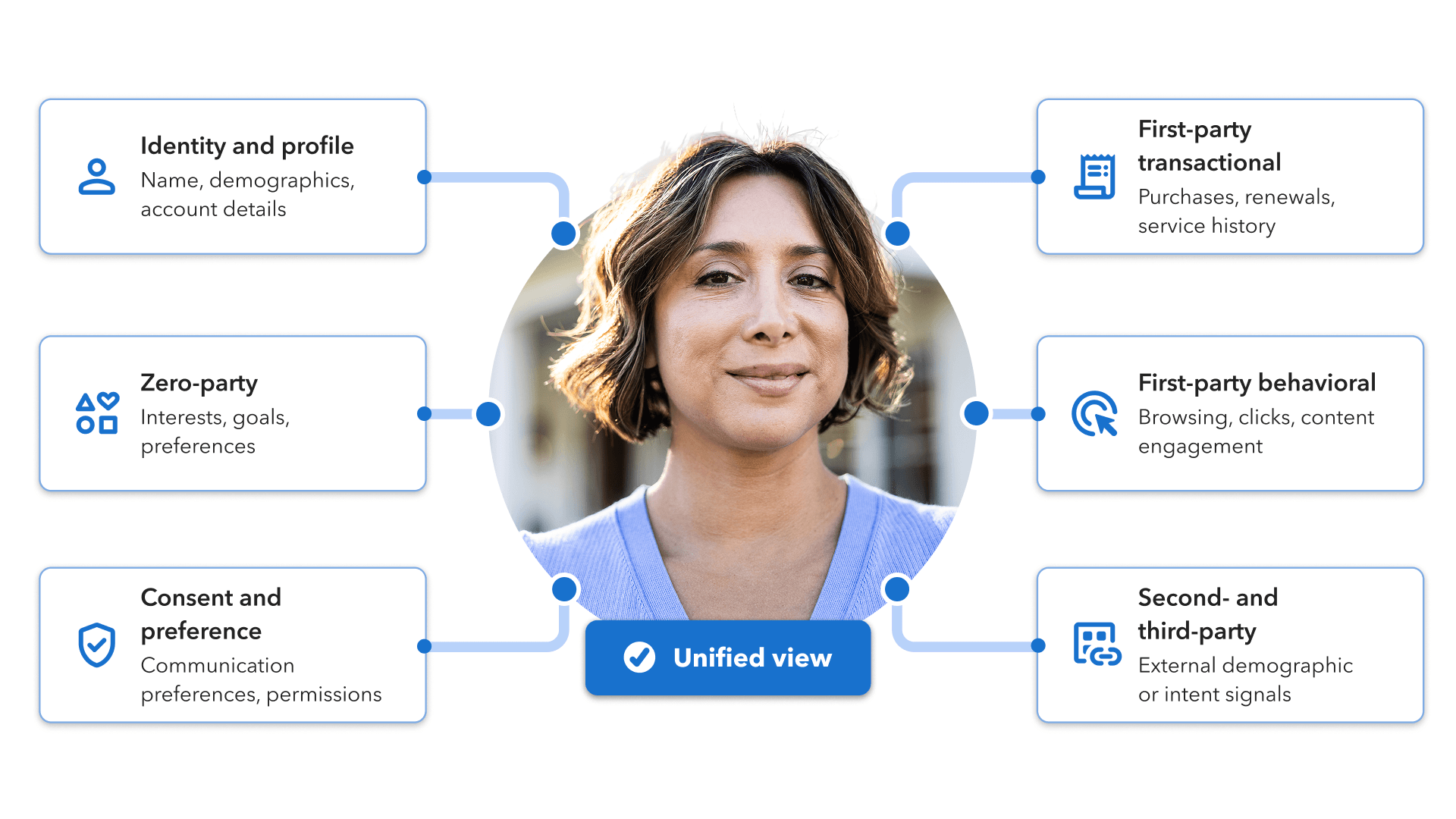
Figure 1. The building blocks of a unified customer loyalty profile. Bringing together customer identity, data, consent, privacy and insights to create a connected customer view.
Most customers don’t think twice about joining a loyalty program at point-of-sale, opting-in to an email list, completing a survey or creating an account. Though these are routine interactions, each one represents an opportunity to gather valuable loyalty program data.
But it’s important to understand that people don’t just give their data away, they exchange it for value. Regardless of the expectation—personalized recommendations, faster service, exclusive content or more relevant experiences—the value exchange should be clear and meaningful to your customers.
For this reason, loyalty programs are uniquely positioned to engage with consumers while simultaneously presenting opportunities to collect data—provided it’s done transparently, with clear purpose, and in exchange for meaningful value.
Ultimately, valuable data can’t be obtained through hidden tracking mechanics or aggressive tactics. When brands are transparent, respecting customer choices and collecting data happens organically as an extension of value-driven moments, like:
The right data and technology put customer privacy first. Our industry-leading customer loyalty platform ensures the highest level of privacy, security and data protection available, providing a foundation for understanding and serving your customers more effectively.
Think back to the times you’ve received a “welcome” notification from a brand you’ve been loyal to for years or earned points in-store, only to discover that it’s not reflected in the brand’s app. Without a unified view of the customer, brands run the risk of treating the same person as multiple, disconnected customers.
This is what makes identity resolution so critical.
It fills in data gaps, connecting customer profiles across touchpoints, devices and systems. Without it, brand communications scale friction and inconsistency instead of personalization—creating experience debt which chips away at the very loyalty you’re trying to build.
Industry-recognized solutions, like Epsilon's COREid, unifies and cleanses your first-party data by attributing a unique, privacy-compliant identifier to each individual customer. This is important because a single customer view allows you to recognize customers on a 1:1 level, and:
Forrester states, "Identity resolution capabilities are a mandatory investment to support consumer insights and engagement in the immediate term, putting buyers in the position of implementing solutions today that meet current marketing needs but also provide the flexibility to adapt to changing conditions in the future.”
That’s where the rubber meets the road. A loyalty platform with native identity management capabilities optimizes identifiers to connect disparate data points, ensuring you can identify your customers and their transactions in real time. When your loyalty data is unified, you can make more informed decisions and continuously maintain accurate member profiles that fuel deeper customer relationships and better customer experiences.
It’s one thing to have a unified customer view, it’s another to use it effectively. Once your customer profiles are unified, you can use it to enhance your first-party data and create member journeys that feel more relevant, recognizing customers at the person level instead of through a transactional view.
As Shamba Schmidt, Vice President of Sales Strategy notes in the Real Deal on Loyalty, "Data is just the start. What comes next is about orchestration, intelligence, and evolution of the customer journey." Activating loyalty across programs requires that same orchestration—connecting customer data, insights and experiences to create value at every touchpoint.
A data activation strategy turns collected data into actionable insights. Whatever your business goals—personalized experiences at scale, better customer service, increased loyalty or improved decision-making—activating your loyalty data transforms every interaction into an opportunity.
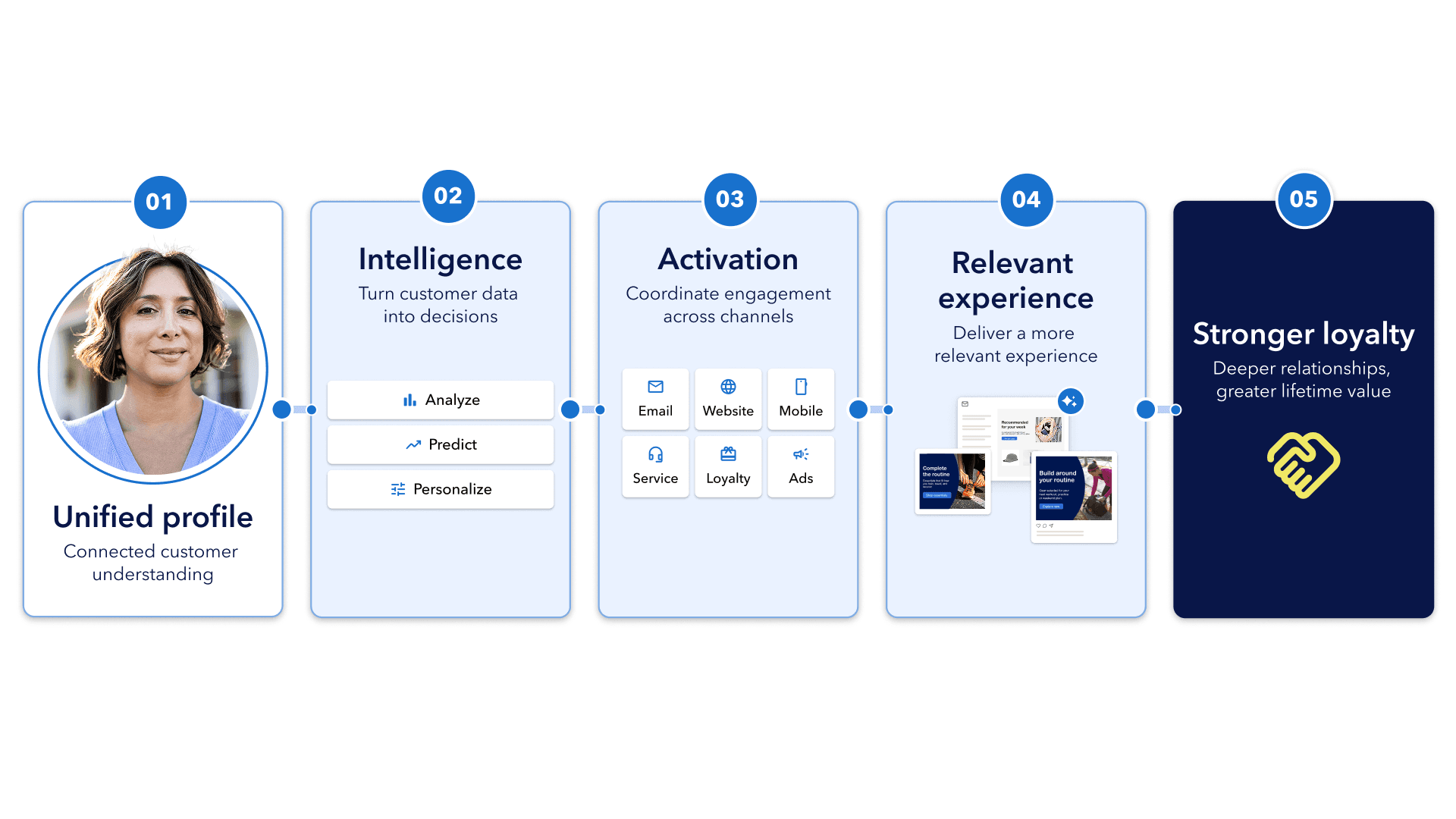
Figure 2. Activating customer insights across the journey. A unified customer profile enables brands to analyze, predict and personalize interactions across email, web, mobile service, loyalty and advertising channels, creating more relevant experiences and building stronger customer loyalty.
Data activation creates opportunities for marketers to create meaningful experiences that boost affinity, drive revenue growth and strengthen loyalty to your brand, providing actionable visibility into:
Customers don’t become loyal because of the data and technology behind a brand; they become loyal because of the experiences a brand delivers.
For this reason, brands that measure beyond customer enrollment and offer redemption, achieve better outcomes. But no single metric tells the whole story of what people love about your brand, or why they don’t.
To truly understand what motivates people to feel connected to your brand, buy your products and share their experiences with others, you need an advanced comprehensive reporting and customer loyalty data analytics dashboard that can combine behavioral, transactional and emotional loyalty.
Customer loyalty metrics—like customer lifetime value, share of wallet and retention rate—show the full picture of customer loyalty. When you understand what makes customers loyal to your brand, you can refine audience segments, optimize personalized experiences and continuously improve program performance.
Our technology indicates where your loyalty investments are creating the desired impact—increasing repeat purchases, bolstering engagement and retention—and where they are not. That’s what happens when you put loyalty metrics to work.
When brands demonstrate they know who their customers are, what they care about and continually curate member journeys that align with their needs and values, customers keep coming back.
Building life-long loyalty starts with knowing your customers—not just what they buy, but what they value. A data-driven loyalty strategy, with identity resolution and real-time activation, is the key to better customer experiences.
Building customer loyalty takes knowing who your customers are on a deep level. For that, brands need to start with a solid first-party data strategy that does more than just collect data. Nurturing true customer loyalty requires the ability to activate insights, measure impact and evolve as your customers change.
Having the right loyalty provider makes all the difference. Whether you're building a new loyalty program or enhancing an existing one, our solutions offer advanced technology, quality data and expert-level support services brands can leverage to continuously improve their loyalty strategy, strengthen customer relationships and drive better outcomes.
Customer loyalty data is the first-party and zero-party information that brands gather to understand, engage and retain customers over time. It includes transactional data, purchase history, website and app behavior, loyalty program activity, preferences, communication choices and information customers intentionally share, such as product interest or shopping preferences.
First-party data is information that a brand observes through consumer-brand interactions, such as purchases, website activity, email engagement, mobile app usage and loyalty program participation. Zero-party data is information customers intentionally and proactively share, including preferences, interests, communications preferences, product needs and survey responses.
Loyalty programs are uniquely positioned to collect both types of customer data organically. As members engage with their loyalty programs, brands can combine their observed behaviors with their shared preferences to create richer customer profiles, improve personalization and deliver more relevant rewards and experiences throughout the customer journey.
Loyalty programs collect customer data through every interaction a member has with a brand. This includes setting up an account, purchase history, offer redemptions, website visits, mobile app activity, email engagement, customer service interactions, surveys, preference centers and in-store transactions.
The best customer loyalty metrics measure both customer engagement and long-term business value. Common KPIs include customer retention rate, repeat purchase rate, customer lifetime value (CLV), loyalty program enrollment, active member rate, reward redemption rate, purchase frequency, average order value, churn rate and customer satisfaction or Net Promoter Score (NPS).
Tracking these metrics together provide a more complete view of loyalty program performance. Rather than focusing on participation alone, brands can evaluate whether their loyalty strategy is increasing engagement, improving retention and driving sustainable revenue growth over time.
Epsilon Loyalty unifies behavioral, transactional, and third-party data, enabling a deeper understanding of each loyalty member in your customer file. These enhanced insights connect to your first-party data and form a holistic view of each person. This unified view allows better marketing activation—segmentation, personalization and measurement—across channels. Our solutions help brands create a closed feedback loop that enriches your customer view over time.
Choose a suggested prompt to keep going after reading


